
NC State Senate District 47
NOTE: You may vote for one. Candidates are presented below in the order they appear on your ballot. All of my research sources and links for these candidates are presented after and below the candidate profiles.
Reason for my Endorsement:
Hise’s record leaves little doubt that he is a reliable member of the Republican Senate majority. In the current 2025–26 session, he has voted with the Senate majority on about 99% of the votes he has cast. So if you like what you’re getting from Raleigh, he’s your man. In Watauga County, however, he shows another use of his accumulated legislative power when power isn’t going where he wants it to: not bringing a local request to Raleigh, but using Raleigh’s authority to determine what happens locally.
And with power comes money. As reported by Transparency USA, campaign finance reports through June 30 show a striking difference in the scale and sources of the two campaigns. Hughes reported $8,531.73 in contributions, with his largest contributors all individuals and none giving more than $1,000. Hise reported $246,760.46. His largest contributors include political action committees representing nurse anesthetists, nurses, orthopedic physicians, asphalt companies and Charter Communications, along with several individuals giving $6,800.
FRANK PATTON HUGHES III (Democrat)
Frank Hughes Website
WHO IS FRANK PATTON HUGHES?
 Hughes is a public-school teacher from Avery County who teaches world history and psychology at McDowell High School. He did not take a straight path from high school to college to a professional career. Before becoming a teacher, Hughes worked construction, roofing and landscaping, repaired cars and held other hands-on jobs. He later attended Cleveland and Caldwell community colleges and earned his bachelor’s degree from Appalachian State University.
Hughes first ran for this Senate seat in 2024 and lost to Republican Sen. Ralph Hise. He is running again in 2026 and described his first run as “trying to build an airplane as I was flying it.” This time he says he started earlier, is knocking on more doors and has a stronger volunteer operation. He depends heavily on direct contact with voters.
Hughes is running on very little money. His campaign describes itself as a small, volunteer-based operation, and Hughes says the state Democratic Party is helping with canvassing and graphic design. Hughes says his main concerns are public schools, access to health care in the mountains and protection of Western North Carolina’s natural resources. He also speaks frequently about data centers, Flock license-plate cameras and term limits for state legislators.
PUBLIC SCHOOLS
Education is the issue Hughes knows from the inside. He has taught in North Carolina public schools since 2014, and his criticism is more specific than simply saying teachers need more money. He talks about the loss of teacher assistants and school programs, larger workloads, old classroom materials and a state pay system that has given much bigger raises to beginning teachers than to many experienced teachers.
His last point checks out. Recent changes to the state salary schedule put much larger percentage increases at the beginning of a teacher’s career than farther up the schedule. Hughes argues that North Carolina also needs to put more money into classrooms, increase teacher and staff pay and stop using public money for private school vouchers. His voucher argument is strongest when he talks about what ‘school choice’ means in a rural place. A voucher can help pay tuition, but it cannot create a nearby private school where none exists, provide a family with an easy drive across mountain roads, or guarantee that a school has room for a child. Hughes’s current campaign policy page says taxpayer money for private school vouchers is draining resources from public schools and says he would fight for “an end to the wasteful voucher system.”
At the same time, the voucher picture in this district is more complicated than the statewide debate sometimes suggests. In the mountain counties I looked at in this district, most voucher recipients were in the lower two income groups, not the wealthier groups that make up a larger share statewide. Hughes is often good at seeing that difference: a program can exist on paper without working the same way for every person or every community.
HEALTH CARE IN THE MOUNTAINS
Hughes makes a similar argument about health care. He says poverty and geography make it harder for mountain residents to get care, and he wants the state to help keep rural hospitals and essential services available close to home. The distinction matters. A hospital does not have to close its doors for a community to lose important medical care. Several mountain hospitals have stopped offering labor and delivery over the years, and other services can be reduced even while the hospital itself remains open. Hughes calls this a “functional closure.”: The building is still there, but some of the care people once received there is not.
He also wants stronger state action toward large corporate health systems, particularly HCA, which owns Mission Health. HCA and Mission have faced lawsuits and government scrutiny over whether promised services have been maintained. Hughes can overstate the case when he talks as if HCA has made no improvements at all, but his larger concern about the loss of local services and corporate accountability is based on a real fight taking place here in Western North Carolina.
FLOCK CAMERAS AND DATA CENTERS
Hughes opposes the growing use of Flock license-plate cameras, calling them mass surveillance. His concern is not simply that a camera photographs a license plate. It is what happens after that information is collected, how long it is kept, who can search it, and how widely a person’s movements can be shared among law-enforcement agencies. There is another side to that argument. Police departments say the cameras help find stolen cars, locate missing people and solve crimes, and some communities have tried to limit retention and sharing rather than get rid of the cameras. Hughes has not been clear about what, short of getting rid of the system, he would support.
The same is true of data centers. Hughes argues that huge data centers can use enormous amounts of electricity and water while leaving ordinary customers to help pay for new power infrastructure. That concern is strong enough now that it is part of a larger state debate over whether data centers and other very large power users should be required to cover the full cost of serving them. Hughes, however, goes farther and says he wants to stop data-center expansion altogether.
Environmental protection is one of Hughes’s three main campaign issues. He says Western North Carolina depends on its forests, pastures and streams for food, jobs and tourism, and that those resources need protection from exploitation. He also connects his opposition to data centers to that concern, arguing that their demands for electricity, water and new infrastructure can put costs on the communities where they locate.Hughes says he opposes unregulated data-center expansion, specifically because of its demands on the electrical grid and water, effects on utility bills, tax incentives, and loss of local control. He says ordinary households should not subsidize infrastructure for large technology companies. He also specifically says he will not accept Duke Energy campaign contributions.
WHAT HUGHES BRINGS TO THE RACE
Hughes is not a career politician. Much of what he says about government starts with something he has seen firsthand: a classroom without enough resources, a teacher farther along in a career, a patient who has to travel for care or a household worried about a utility bill. Hughes is especially good at looking at a system from the point where it reaches an actual person. What comes through most consistently with Hughes is a candidate whose politics grow out of work, teaching, and life in the mountains.
ENDORSEMENTS: None located/verified
RALPH HISE (Republican)
https://ralphhise.com/
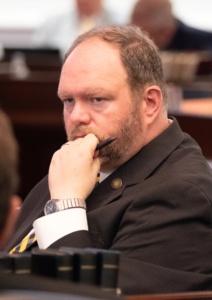
WHO IS RALPH HISE?
Hise is a Mitchell County native. He attended Mitchell High School and the North Carolina School of Science and Mathematics before earning a bachelor’s degree in statistics from Appalachian State University and a master’s degree in higher education administration from NC State. He worked at Mayland Community College and served two terms as mayor of Spruce Pine before being elected to the state Senate in 2010. He also worked in Republican Party campaigns and served as chairman and vice chairman of the Mitchell County Republican Party.
Hise has been in the North Carolina Senate long enough that simply listing his votes doesn’t tell you very much about him anymore. The more revealing question is where he has accumulated power and what he does with it.
Hise is now serving his eighth Senate term and is Deputy President Pro Tempore. He chairs the Senate Appropriations/Base Budget Committee and the Elections Committee and also serves on Finance, Health Care, Rules and other committees. In other words, Hise is no longer simply one of 50 senators casting votes. He is part of the Senate leadership and has a hand in some of the places where legislation and state spending are shaped before the final vote occurs.
HEALTH CARE: HE’S MORE THAN A VOTE
One theme runs through much of Hise’s healthcare work: having insurance is not necessarily the same thing as having access to health care. That distinction matters in a rural district where a patient can have coverage and still have trouble finding a doctor, specialist or facility close enough to use it.
Hise was involved early in the Republican effort to restructure North Carolina Medicaid. In 2015 the General Assembly approved Medicaid Transformation, moving the state from its traditional fee-for-service system toward contracts under which health plans would receive fixed payments and assume financial risk for patient care. The law created a new Division of Health Benefits and legislative oversight of the transition. Hise was a presiding co-chair of the Medicaid oversight committee, and in 2016 he was the primary sponsor of follow-up legislation requiring detailed implementation reports and making additional changes to the transformation law.
Hise also opposed Medicaid expansion for years before becoming part of the Senate’s eventual move toward expansion. In 2023 he voted for the bipartisan final bill extending Medicaid coverage to additional low-income adults. Hise has also supported efforts aimed at expanding the supply of rural health-care providers, changing certificate-of-need restrictions and expanding what some health professionals can do. Whether all these Hise approaches solve the problem is another question. The difference between creating a program and making it work on the ground turns up elsewhere in Hise’s record.
BRINGING STATE MONEY HOME
Hise is a senior budget writer, and local governments throughout his district have repeatedly turned to him for help getting projects into the state budget. In July 2021, county commissioners were discussing how to pay for a badly needed law-enforcement center. Mitchell County Manager Tim Greene relayed the need to Hise, and Hise agreed to incorporate the project into the upcoming state budget.
Beech Mountain offers another example. The town had a specific problem, an inadequate water supply during drought and had developed a plan for a second emergency reservoir. In 2023 the town formally thanked Hise, Rep. Dudley Greene and Rep. Ray Pickett after the state budget included $14 million for Beech Mountain’s water infrastructure. Yancey County’s 2025–26 budget similarly credits Hise with helping make possible state appropriations for its new Public Safety and 911 Center and for five water and sewer projects.
There is another side to this story however. In a 2021 budget, projects in Hise’s then six-county district received at least $73 million in direct appropriations, one of the largest totals attributed to any Senate district. At the same time, some poor rural counties elsewhere in North Carolina received no comparable direct appropriations and instead had to compete for statewide grant funds.
HELENE: APPROPRIATED IS NOT THE SAME AS DELIVERED
Much of Hise’s district was among the hardest hit territory in North Carolina, including his home area around Spruce Pine and Mitchell County. In the immediate aftermath, Hise described system and other failures on a scale he said he had not encountered in previous mountain disasters. In response, Hise was one of the primary sponsors of SB671, which proposed a $40 million program to replace revenue lost by Helene-damaged local governments along with property tax relief and other assistance. The bill was sent to the Senate Appropriations Committee but did not become law.
Much of Hise’s work focused on a problem western communities learned quickly after Helene: government can announce millions of dollars for disaster recovery while a town still doesn’t have money it can actually use to rebuild a water plant, road or bridge.
WHEN RALEIGH DECIDES FOR THE LOCALS
Hise’s relationship with local government looks different in Watauga County, however. In 2023, Hise sponsored Senate Bill 759, which replaced Watauga County’s system for electing commissioners with five single member districts. Under the law, voters in each district elect only the commissioner from that district.
Watauga commissioners subsequently put a different structure before county voters: three single member districts and two commissioners elected countywide. But before that referendum was held, Hise introduced SB912. The legislation applied his same five legislative districts to the Watauga Board of Education and provided that any referendum Watauga voters approved would not take effect until after the 2032 general election.
Watauga voters responded in November 2024 by approving the county referendum 20,073 to 8,078 (about 71% to 29%). The measure carried a majority in every one of the county’s 20 precincts. The dispute is now in federal court. A judge denied the plaintiffs’ request to block the Hise districts while the case proceeds, so those districts have remained in place for this election, but the underlying constitutional claims are still in federal court.
The contrast with Hise’s local appropriations work is worth noticing. He can be a conduit through which local governments seek help from Raleigh. In Watauga election law, he used state legislative authority to determine how a local government will be elected despite a subsequent voter referendum choosing another system.
SCHOOL CHOICE
Hise has supported North Carolina’s expansion of school vouchers, the state program that uses public money to help families pay private-school tuition. The 2023 state budget removed income and prior-public-school attendance requirements, making the program broadly available to North Carolina students. Scholarship amounts still vary by family income, and later budgets increased funding for the program. But school choice can look different in Hise’s mountain district than it does in Charlotte or Raleigh. Some rural counties have few participating private schools within a practical driving distance. A voucher can help a family pay for an available private school; it cannot create one where none exists.
SOCIAL ISSUES
Hise voted for North Carolina’s 2023 law generally prohibiting abortions after 12 weeks, subject to specified later exceptions, and voted to override Gov. Roy Cooper’s veto of the bill. Hise also supported 2023 legislation restricting transgender participation on female school sports teams, prohibiting specified gender-transition medical treatment for minors, and establishing the Parents’ Bill of Rights, which includes parental notification requirements involving a child’s name or pronouns at school. He also voted to override Cooper’s veto of all three measures. Earlier, Hise voted for HB2, the controversial 2016 law governing bathroom use in public facilities and restricting local nondiscrimination ordinances. On guns, Hise supported the 2023 repeal of North Carolina’s pistol purchase permit requirement and voted to override Cooper’s veto.
WHO FUNDS HISE?
Hise’s campaign has raised about $250,000 in the 2025–26 thus far. His largest current contributor is the NC Republican Senate Caucus at $10,000. Since 2017, Hise’s largest cumulative contributors include the NC Association of Nurse Anesthetists PAC, Eastern Band of Cherokee Indians, NC Republican Party, Blue Cross and Blue Shield of NC employee PAC, OrthoCarolina PAC, Duke Energy PAC, Charter Communications PAC, EmergeOrtho PAC, the NC Senate Majority Fund and Carolina Asphalt Pavement Association PAC. Health-care interests are particularly prominent among the long-term contributors.
There is another side of his campaign finances that may say even more about his position in Raleigh. Since 2017, Hise’s campaign committee has reported approximately $640,100 in payments to the North Carolina Senate Majority Fund, according to compiled state campaign-finance records. That means Hise isn’t simply receiving support from the Republican Senate political organization. His campaign has also put substantial money back into the broader effort to elect Republican senators.
ENDORSEMENTS:
Human Coalition Action: anti-abortion/pro-life movement
SOURCES/LINKS for Frank Hughes
- Frank Hughes for NC Senate: campaign website and policy positions
- Frank Hughes for NC Senate: detailed policy positions
- ActBlue: Frank Hughes campaign biography
- Smoky Mountain News: “Hughes aims to unseat veteran Sen. Ralph Hise,” Aug. 26, 2026
- Frank Hughes: March 2026 Reddit AMA
- WataugaWatch: 2024 interview with Frank Hughes
- North Carolina DPI: teacher salary schedules
- NC General Assembly Fiscal Research: 2024–25 Opportunity Scholarship recipients by county and income tier
- NCSEAA: Opportunity Scholarship FAQ and Direct Payment School rules
- Carolina Public Press: rural hospital labor-and-delivery closures
- North Carolina Department of Justice: HCA/Mission lawsuit proceeding to trial
- Mission Health Independent Monitor: compliance reports
- North Carolina General Statutes §20-183.31: automatic license plate reader use
- North Carolina General Statutes §20-183.32: ALPR retention and disclosure
- City of Raleigh: Flock camera use, safeguards and reported results
- NC Newsline: Attorney General proposal for a separate data-center rate class, Sept. 14, 2026
- Duke Energy: company response on data-center growth and customer costs
- Transparency USA: 2026 NC Senate District 47 campaign-finance totals
- North Carolina State Board of Elections: 2025–26 campaign-finance reporting schedule
- NCDOT: history of the 1921 statewide highway program
- Appalachian Regional Commission: history of investment in Appalachia
- NC Governor: state and federal Hurricane Helene recovery funding, June 2026
SOURCES/LINK for Ralph Hise
- NC General Assembly: Senator Ralph Hise biography and current committee assignments
- NC General Assembly: 2015 Medicaid Transformation law (HB 372 / S.L. 2015-245)
- NC General Assembly: 2015–16 Medicaid Oversight Committee report (Hise as co-chair/presiding co-chair)
- NC General Assembly: SB 838, Medicaid Transformation Modifications (2016), Hise primary sponsor
- NC General Assembly: HB 76, Access to Healthcare Options, Senate vote (2023)
- NC Health News / Center for Health Journalism: Hise’s earlier opposition to Medicaid expansion
- ABC11 / Associated Press: Hise on the Senate’s shift toward Medicaid expansion (2022)
- News & Observer: Hise on provider capacity and Medicaid expansion (2023)
- Mitchell County: July 6, 2021 County Commission minutes (law-enforcement center request)
- Town of Beech Mountain: Lake Coffey Drought Mitigation Project
- Yancey County: FY 2025–26 Budget Message
- News & Observer: 2021 local appropriations by legislative district
- NC General Assembly: SB 671, Helene Revenue Replacement / Local Government Property Tax Relief
- NC General Assembly: SB 671 filed bill text ($40 million revenue-replacement program)
- NC General Assembly: SB 759 / S.L. 2023-147, Watauga County commissioner districts
- NC General Assembly: SB 912 / S.L. 2024-13, Watauga school-board districts and referendum timing
- NC State Board of Elections: 2024 certified statewide abstract (Watauga referendum totals)
- WFDD: Watauga referendum results with all 20 precincts reporting
- Federal court docket: Watauga County Voting Rights Task Force et al. v. Watauga County Board of Elections et al.
- NC General Assembly: 2023 Appropriations Act vote history (HB 259)
- NC General Assembly: SB 20 abortion-law veto override, Senate vote
- NC General Assembly: HB 574, Fairness in Women’s Sports Act
- NC General Assembly: HB 808, Gender Transition/Minors, Senate vote
- NC General Assembly: SB 49, Parents’ Bill of Rights
- Blue Ridge Public Radio: Hise discussing HB2 at the 2016 NCGOP convention
- NC General Assembly: SB 41 pistol-purchase permit repeal, veto override vote
- NC State Board of Elections: campaign finance search tools
- Lapel Intelligence: Hise 2025–26 campaign-finance compilation sourced to NCSBE
- Transparency USA: Hise campaign finance, 2017 to present
- NC General Assembly: 2025–26 Senate Member Vote Statistics